The Volcano Lover
"One cannot use the life to interpret the work. But one can use the work to interpret the life."

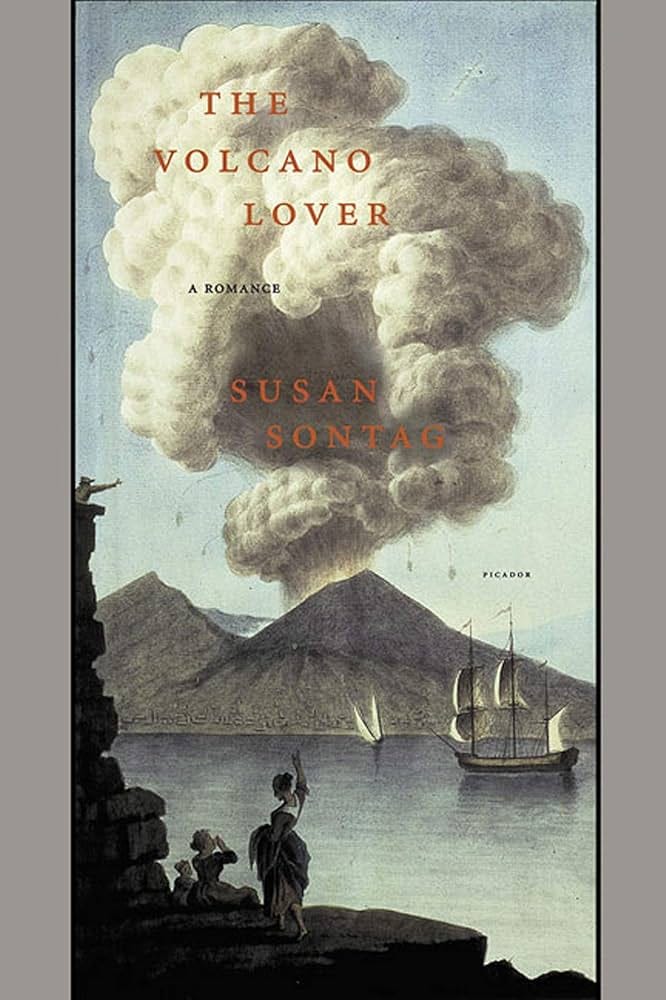
“One cannot use the life to interpret the work. But one can use the work to interpret the life,” Susan Sontag writes in “Under the Sign of Saturn.” The author isn’t dead, but rather unconscious.
In that essay, Sontag is writing about Walter Benjamin and the way he “projected himself, his temperament, into all his major subjects.” Benjamin Moser and others have said Sontag is guilty of this same projection; writing about Benjamin, Barthes, or Brecht, she’s really writing about herself.
While I enjoy this quality in her nonfiction, I’m finding it much more frustrating and unfulfilling in her fiction. Aside from the fact that The Volcano Lover is historical fiction (one strike for me), the book is painstakingly a novel of ideas. Historical fiction is already fussy, collecting and recycling source material, molding it into the shape of a narrative—like overworked dough, the book is tough.
Kneading: suppressing the voice of the historian. Working out those air bubbles to let the story speak for itself.
Sontag has a hard time doing this. Her narrator juts in at every turn, judging, theorizing, interpreting. Not content to let her readers make meaning themselves, the narrator interjects and offers her own claims, often about collecting and the figure of the collector. In this way, Sontag projects herself into both the book and Benjamin, whose ideas about the collector she’s responding to.
Considering I like her nonfiction and feel annoyed by her fiction (so far), I love these interruptions; these are the only moments when I perk up, pick up my pen. The novel opens (so promising) with a present-day narrator entering a flea market,
“Why enter? What do you expect to see? I’m seeing. I’m checking on what’s in the world. What’s left. What’s discarded. What’s no longer cherished. What had to be sacrificed. What someone thought might interest someone else. But it’s rubbish. If there, here, it’s already been sifted through. But there may be something valuable, there. Not valuable, exactly. But something I would want. Want to rescue. Something that speaks to me. To my longings. Speaks to, speaks of. Ah…”
Then, we get thrust into the past: 18th-century Naples. Appropriately, the protagonist of the novel is himself a collector; the Cavaliere prides himself on collections of all shapes and sizes and values the process of collecting itself: “Collecting expresses a free-floating desire that attaches and re-attaches itself—it is a succession of desires. The true collector is in the grip not of what is collected but of collecting.” Fifty pages later, the narrator adds, “A complete collection is a dead collection.” And a hundred pages after that: “Collectors have a divided consciousness. No one is more naturally allied with the forces in a society that preserve and conserve. But every collector is also an accomplice of the ideal of destruction.”
Trudging through the Cavaliere’s pathetic existence, I light on these moments of ideation (and occasionally on his treks up to Vesuvius, an object of his fixation), wishing the book weren’t a 400-some-page novel and instead a slim book-long essay.
It makes sense to me, a nonfiction writer who focuses on the writings of other people, that the way into writing fiction would be historical fiction or rewrites of other works. (The only fiction project I’ve started in the past five years is one that novelizes the relationship between Anne Sexton and her final therapist, Barbara Schwartz—a subject I’ve written nonfiction about.) Sontag writes this kind of fiction in her short stories collection I, etcetera; in one story, she rewrites The Strange Case of Dr Jekyll and Mr Hyde, in another Pygmalion.
For me, when I wrote (write?) fiction, I always needed a source text: my own life, other books, history. I couldn’t come up with a story out of thin air; it had to start somewhere. Is this the result of some deficit in my imaginative capacity? Did Sontag share in this inability to conjure stories out of nowhere?
She certainly wouldn’t want me thinking so. In the last fifteen years of her life, Sontag resented when people didn’t read her fiction or thought of her as an essayist rather than a novelist. Terry Castle writes about this in her essay “Desperately Seeking Susan” citing Sontag’s frequent complaints that “no one had yet appreciated the true worth of her novel The Volcano Lover” and “people had yet to grasp the greatness of her fiction.” Unfortunate for Sontag, I have yet to appreciate or grasp The Volcano Lover’s worth, though I do have over one-hundred pages left.
Perfect description of historical fiction